Multi‑Location Retail Security: How Enterprise Retailers Are Operationalizing Proactive Visual Monitoring at Scale
Organized retail crime (ORC) doesn’t target a single store — it targets an entire portfolio. For enterprise retail Loss Prevention (LP) and Asset Protection leaders responsible for dozens or hundreds of locations, the challenge isn’t installing cameras. It’s multi-location retail security that operationalizes consistent, real-time protection across every site, without scaling headcount or accepting blind spots.
In our first guide, we examined why smash-and-grab incidents overwhelm reactive systems. In the second, we explored why CCTV alone isn’t enough to prevent retail theft. This third guide focuses on the critical next step: how enterprise retailers are running proactive visual security as an operating model across multi-location environments.
Why Traditional Retail Security Systems Break Down at Scale
Most retail security systems and loss prevention technology were designed for single‑site use. When replicated across a large footprint, their limitations compound:
- Delayed response: Alarms trigger after incidents begin, often without visual context.
- Fragmented workflows: Cameras, alarms, and monitoring systems operate in silos.
- Inconsistent standards: Locations follow different procedures and response norms.
- False‑alarm fatigue: High volumes of non‑threat alerts erode urgency and trust.
Limited visibility: Loss Prevention teams can’t be physically present everywhere at once. In practice, alarms fire without context, footage is reviewed after incidents occur, and local staff are expected to respond — even after hours or in unsafe situations. Over time, this inconsistency creates predictable gaps that organized retail crime groups exploit.
At scale, the core problem isn’t coverage — it’s coordination. Traditional systems don’t provide the real-time visibility required for centralized action and organized retail crime prevention. The resulting gap between when suspicious behavior begins and when anyone can intervene is where enterprise risk lives.
What Proactive Security Changes — Operationally
Proactive visual security transforms retail security from a collection of tools into a repeatable operating model.
Instead of treating each store as an independent security island, enterprise teams centralize detection, standardize response, and extend coverage remotely.
For multi‑location retail, this isn’t about adding more cameras. It’s about changing how security operates across the portfolio:
- Real–time video verification alarms: When an alert triggers, operators see live video immediately, allowing threats to be assessed in seconds, not after the fact.
- Remote deterrence: Through two‑way audio and visual deterrents, operators can intervene remotely, issuing live voice warnings or activating lights to de‑escalate situations before they escalate.
- Centralized visibility: Enterprise teams gain a unified operational view across stores, yards, and facilities — often through a Security Operations Center (SOC).
- Standardized response: Every site follows the same alert → verify → intervene workflow, strengthening governance and consistency.
- Fewer false alarms, faster real responses: AI‑powered detection filters routine activity, allowing operators to focus on genuine threats.
Operationally, this proactive retail security model runs on a simple, consistent loop across all locations:
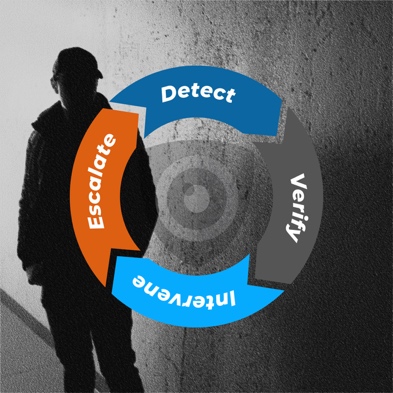
Platforms like CHeKT enable this loop through centralized security management that puts live video at the heart of every alert, rather than treating video as something reviewed later.
Operationalizing Detection Without Creating Noise
At enterprise scale, detection must be selective, not exhaustive. Motion‑based systems generate too many false alarms, overwhelming operators and reducing confidence in alerts.
Proactive visual security operationalizes detection through AI–powered behavioral analysis, not raw motion.
Instead of flagging every passing car or shadow, the system focuses on behaviors that precede incidents. Loitering detection near entrances, unauthorized after-hours access, or unusual group movement patterns are all part of its core capabilities.
Operationally, this delivers three advantages:
- Fewer alerts entering the system
- Earlier visibility into pre‑incident behavior
- Consistent detection standards across all locations
At scale, leadership’s role isn’t observation. It’s assurance that every location is being monitored the same way.
Standardizing the Alert → Verify → Intervene Workflow
In multi-location environments, inconsistency is one of the greatest risks. Different stores following different alarm signals and security protocols creates uneven protection across the network.
Proactive visual security replaces ad‑hoc response with a platform‑driven, standardized workflow:
- An AI‑confirmed event triggers an alert
- Live video is immediately available to an operator
- The operator verifies the situation visually
- Deterrence is activated or response escalated
This isn’t just about speed — it’s about governance. Operators aren’t reacting blindly to alarms; they’re acting on verified visual information, following the same protocol across every site.
The result is:
- Faster, more confident response
- Better coordination with monitoring centers and law enforcement
- Defensible, repeatable response standards
At scale, consistency is more valuable than any individual feature.
The Technology Stack Behind Multi‑Site Security Operations
Effective multi‑site security depends on a coordinated technology stack, with each layer reinforcing the others:
- Smart cameras with proactive detection: Cameras analyze behavior to facilitate real-time security alerts, not just record events.
- Centralized security control panels: These act as the intelligence layer, routing verified events and responses through a unified system.
- IP audio and visual deterrents: Integrated speakers and deterrents enable immediate, remote intervention.
Professional monitoring platforms: Monitoring portals unify live video, alarms, maps, and response tools into a single interface.
Together, these components enable centralized security management, which is foundational for scalable retail security.
What Enterprise Retailers Should Look for in a Multi-Location Security Platform
When evaluating platforms for multi‑location retail security teams, enterprise leaders should focus on outcomes, not specs.
Key criteria include:
- Scalability: Can the platform support 10 locations today and 500 tomorrow without re‑engineering?
- Real‑time verification: Can Loss Prevention teams verify alerts remotely without dispatching guards?
- Integration: Does it work with existing cameras, alarm panels, and monitoring infrastructure?
- Remote deterrence: Can threats be addressed before loss or injury occurs?
- Centralized reporting: Can leadership measure performance consistently across the portfolio?
- Enterprise‑grade support: Is there a certified dealer and monitoring ecosystem that understands scale?
These questions distinguish reactive camera deployments from true enterprise security platforms.
How CHeKT Functions as the Reference Architecture for Multi-Location Retail Security
CHeKT is designed to support this operating model at enterprise scale. Rather than replacing existing infrastructure, it acts as a connective layer that unifies cameras, AI analytics, alarm panels, and deterrents into a single proactive system. Core elements include:
- AI‑powered detection that filters noise and identifies real threats
- Smart cameras with proactive detection
- Live video verification shared instantly with operators
- Two-way audio and visual deterrence for real-time intervention
- Centralized video control panels and monitoring portals
- Cloud‑based, verified video retention supporting investigations and compliance
This architecture allows enterprise retailers to run one consistent security model across 10, 50, or 500+ locations without reinventing processes at each site. High-value retailers already are reaping the benefits of this integrated security system.
Extending Coverage Without Extending Headcount
Enterprise LP teams are almost always resource constrained. Scaling traditional security often means adding guards or patrols and that doesn’t scale efficiently.
Proactive visual security enables remote video monitoring for retail with a virtual guard model:
- Cameras act as always‑on detection points
- Operators provide remote oversight across many sites
- Two‑way audio and deterrents allow live intervention without sending someone on site
With CHeKT, operators can issue real‑time voice warnings or activate deterrents the moment suspicious behavior is verified—often stopping incidents before loss or injury occurs.
Operationally, this allows enterprise teams to:
- Reserve on‑site resources for high‑risk situations
- Maintain consistent after‑hours coverage
- Scale protection without proportional labor increases
Making Employee Safety a First‑Class Operational Outcome
At enterprise scale, retail loss prevention and employee safety are inseparable. Lone workers, after-hours staff, and high-risk interior environments all require real-time awareness, not delayed review.
Proactive visual security supports employee safety by:
- Providing live visibility into interior and exterior spaces
- Allowing operators to intervene remotely before situations escalate
- Reducing reliance on staff to assess or confront threats
When incidents occur, operators see what’s happening immediately and can escalate response without placing employees in harm’s way. For leadership, this creates a defensible safety posture aligned with duty‑of‑care and liability obligations.
Centralized Oversight, Reporting, and Governance
Enterprise security must be effective and auditable.
Because proactive visual security platforms store verified events and video evidence in the cloud, LP teams gain consistent visibility into how incidents are detected and handled across the portfolio. This enables:
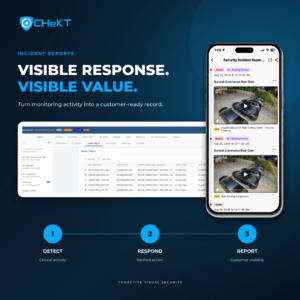
- Centralized incident review, backed by structured incident reports that turn raw events into a customer-ready record
- Reliable evidence for investigations and insurance
- Consistent reporting across regions
Instead of anecdotal updates, leadership can evaluate security performance as a system—across locations, time periods, and risk categories.