Why a cannabis dispensary security system is different from traditional retail security
A cannabis dispensary security system must do far more than prevent theft. Today’s dispensaries operate in one of the most highly regulated retail environments, where operators must protect high-value inventory, support employee safety, maintain regulatory compliance, and preserve audit-ready evidence.
Modern proactive monitoring helps organizations meet these objectives while strengthening security across every location.
Every incident has two consequences.
The first is the operational impact.
The second is the compliance impact.
A break-in is not simply a loss event. It may trigger reporting requirements, regulatory review, insurance investigations, inventory reconciliation, and questions about whether the facility meets security obligations.
That reality fundamentally changes how cannabis operators should think about security.
Unlike many traditional retailers, dispensaries often maintain high-value inventory, process cash transactions, manage restricted-access areas, and operate under detailed security plans approved during licensing.
Many operators are moving beyond passive surveillance and implementing a proactive visual security platform that provides more than recorded footage.
The goal is no longer simply documenting incidents.
The goal is protecting the license, protecting the inventory, protecting employees, and preserving evidence when regulators, insurers, or law enforcement request answers.
What Regulations Commonly Require
For reference, operators can review state cannabis security regulations and applicable licensing requirements.
Important note: Cannabis security requirements vary significantly by state, municipality, license type, and regulatory authority. Operators should always consult legal counsel, licensing authorities, and their security integrator before finalizing a compliance strategy.
Despite regional differences, most cannabis security regulations focus on the same core categories.
These requirements commonly influence the design of cannabis security camera solutions, including coverage areas, footage retention, remote access capabilities, and documentation practices.
Minimum Camera Coverage
Most security plans require video coverage of key operational areas, including:
- Entrances and exits
- Sales floors
- Point-of-sale stations
- Product display areas
- Vaults and storage rooms
- Receiving and loading zones
- Exterior perimeters
- Employee-only areas
- Restricted-access rooms
- Cultivation or processing areas where applicable
A practical compliance question is not:
“Do we have cameras?”
It is:
“Can we clearly document activity in every area regulators expect us to monitor?”
Restricted Access Areas
Most cannabis regulations place special emphasis on controlling access to areas containing inventory, cash, or sensitive operations.
These areas commonly include:
- Product vaults
- Inventory rooms
- Processing spaces
- Receiving areas
- Employee-only zones
Security leaders should ensure both access events and video evidence are available whenever activity occurs in these locations.
Audit and Inspection Readiness
Many operators focus heavily on preventing theft while overlooking a different risk: failing to produce documentation when requested.
Regulators, insurers, and investigators often expect operators to quickly retrieve footage, document events, and demonstrate adherence to approved security procedures.
The ability to locate and export evidence quickly is often just as important as capturing it.
Video Retention: Planning for Audits Before They Happen
Every cannabis dispensary security system should include a documented retention strategy aligned with applicable state regulations.
Video retention remains one of the most commonly cited compliance requirements across cannabis markets.
Retention periods vary by state and license type, with many jurisdictions requiring footage retention periods ranging from 30 to 90 days.
The safest approach is to design retention policies around the strictest applicable requirement.
An effective retention strategy should include:
- Defined retention schedules
- Secure storage procedures
- Backup strategies
- Incident preservation workflows
- Export capabilities
- Audit retrieval procedures
Solutions such as Video Vault help operators preserve footage, retrieve evidence quickly, and support audit preparation.
Organizations should also periodically test footage retrieval procedures rather than assuming footage will be available when needed.
A compliance plan is only as strong as its ability to produce evidence during an audit.
Remote Viewing vs Live Monitoring
A modern cannabis dispensary security system should support both remote viewing and monitored video verification. One of the most misunderstood areas of cannabis security is the difference between remote viewing and active monitoring.
Remote viewing allows authorized personnel to access live or recorded footage.
Live monitoring introduces an entirely different operational capability.
When suspicious activity occurs:
- Video is reviewed
- Events are verified
- Escalation procedures begin
- Security personnel receive actionable information
Modern video verification workflows provide operators with visual context before a response is initiated.
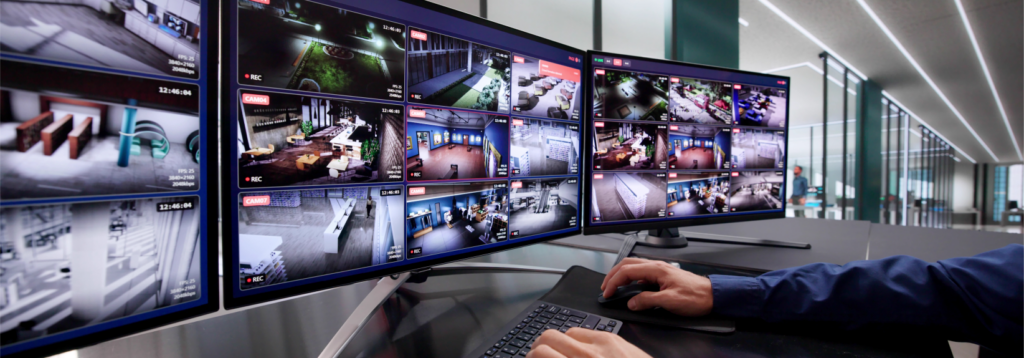
Monitoring personnel can review activity through a centralized Video Control Panel and determine whether escalation is necessary.
This distinction is especially important for operators evaluating cannabis security camera monitoring and cannabis remote video surveillance solutions.
A camera that can be viewed remotely does not necessarily provide active protection.
Monitored verification transforms surveillance into an operational security tool.
Access Control and Video: Better Together
Most cannabis security plans include access-control requirements for restricted areas.
Access-control systems create logs.
Video creates context.
Together, they provide accountability.
When integrated properly, every door event can be paired with visual evidence showing who entered, when they entered, and what activity occurred.
This approach strengthens:
- Compliance documentation
- Internal investigations
- Inventory accountability
- Employee safety
- Audit readiness
Solutions such as the CHeKT Video Control Panel help unify cameras, alarms, and access-control events into a single workflow.
Rather than operating as separate systems, video and access control become part of a coordinated security strategy.
Proactive Monitoring vs. Passive Surveillance
| Passive CCTV | Proactive Visual Security |
|---|---|
| Records incidents | Helps deter incidents |
| Reviewed after events occur | Evaluated as events develop |
| Limited alarm context | Video-verified events |
| No intervention capability | Real-time intervention |
| Reactive investigation | Proactive response workflows |
| Evidence after loss | Prevention plus evidence |
Many competitors focus almost exclusively on cameras.
Cameras are important.
But compliance, security, and operational resilience increasingly depend on what happens after detection.
The strongest security programs combine surveillance, verification, deterrence, response, and documentation into a single process.
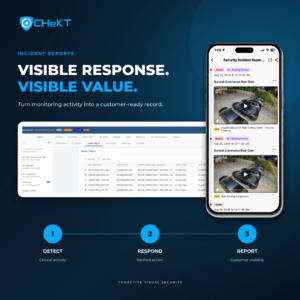
CHeKT’s proactive visual security approach has been deployed across high-risk commercial environments including construction sites, warehouses, and vehicle lots. These deployments demonstrate how verified video workflows can help identify suspicious activity, support intervention, and preserve evidence across industries where asset protection is critical.
Protecting High-Value Inventory After Hours
Cannabis facilities combine several characteristics that make them attractive targets:
- High-value inventory
- Cash handling
- Public access
- Restricted-access areas
- Regulatory scrutiny
After-hours intrusion remains one of the most significant threats facing dispensaries.
This is where proactive monitoring provides meaningful value.
Whether using existing ONVIF-compliant cameras or CHeKT Smart Security Cameras, operators can identify suspicious activity around vaults, receiving areas, and exterior perimeters before losses occur. CHeKT Smart Security Cameras further enhance proactive security with advanced analytics designed to detect and escalate potential threats.
Integrated IP Speakers for verbal deterrence allow operators to intervene immediately when suspicious behavior is detected.
A live operator can issue warnings, challenge unauthorized individuals, and communicate that authorities have been notified.
Real-world examples demonstrate how incidents can move from detection to apprehension when proactive monitoring and verified response work together.
Understanding broader retail crime trends can also help operators evaluate their exposure to theft, burglary, and organized retail crime.
Building an Audit-Ready Cannabis Dispensary Security System
An audit-ready cannabis security program should include more than cameras.
A complete strategy typically includes:
- Video Coverage. Comprehensive monitoring of all required areas.
- Access Control. Protection of restricted-access locations.
- Video Retention. Policies aligned with regulatory requirements.
- Evidence Management. Rapid retrieval and export of incident footage.
- Monitored Verification. Visual confirmation before escalation.
- Audible Deterrence. Real-time intervention when appropriate.
- Documentation. Clear chain of review and evidence preservation.
Security leaders often rely on security best practices for regulated businesses when developing compliance-focused monitoring programs.
Together, these components create a stronger compliance posture than any individual technology alone.
A complete proactive visual security architecture can include existing camera integration, monitored video verification, Video Control Panel workflows, Video Vault evidence management, Mobile App access, and IP Speakers for audible deterrence.
Scaling Compliance Across Multiple Locations
Protecting one dispensary is challenging.
Protecting 50 locations is a completely different operational problem.
Multi-location operators need:
- Standardized policies
- Centralized oversight
- Consistent retention practices
- Unified incident documentation
- Repeatable response procedures
Many operators choose to upgrade existing security systems rather than replace functioning infrastructure.
By leveraging the CHeKT Video Control Panel, organizations can connect existing cameras and alarms to centralized monitoring workflows while maintaining consistent standards across every location.
This reduces capital expenditures while improving compliance management.
For regulated businesses, the cost of security should be evaluated against the potential impact of a single incident, including lost inventory, operational disruption, regulatory review, insurance claims, and reputational damage.
Questions to Ask Your Security Provider
Before selecting a cannabis security platform, ask:
- Can the system support applicable retention requirements?
- How quickly can footage be retrieved?
- Can access-control events trigger video review?
- Is monitored video verification available?
- Can operators remotely access live and recorded footage?
- How are incidents documented?
- How is evidence preserved for audits?
- Can the platform scale across multiple locations?
- Can existing cameras and alarm systems be integrated?
- What happens when suspicious activity is detected after hours?
The answers often reveal the difference between a camera system and a security strategy.