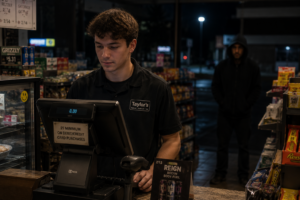
Employees working alone face unique risks that many traditional security systems were never designed to address. Whether it’s a retail associate closing a store after hours, a convenience store clerk working a late shift, or a maintenance technician servicing equipment overnight, lone workers often operate outside the visibility and support systems that protect most teams.
The challenge isn’t simply collecting information about incidents after they happen. The real problem is that when someone is working alone, no one may know something is wrong until it’s too late.
This is why lone worker safety monitoring has become a critical priority for safety leaders. Modern lone worker protection systems combine detection, alerting, and response capabilities ensuring that if an incident occurs, help can be dispatched quickly and accurately. Increasingly, organizations are discovering that proactive video monitoring adds a crucial layer of situational awareness that traditional safety devices alone cannot provide.

What Is Lone Worker Safety Monitoring?
At its core, lone worker monitoring is the process of detecting when an employee working alone may be in danger and triggering a response. An effective lone worker monitoring system typically combines several functions:
- Check-in procedures: Regularly scheduled sessions to verify status.
- Panic buttons: Discreet duress alerts for immediate help.
- Automatic detection: Man-down or fall detection devices to alert when a worker is incapacitated.
- Location monitoring: GPS tracking or geofencing to maintain visibility.
- Escalation: Professional monitoring centers or supervisor alerts to ensure response.
Why Lone Workers Face Unique Risks
Workers who operate alone face risks that differ significantly from those in well-staffed environments. A typical lone worker incident may involve workplace violence, medical emergencies, or physical accidents like slips and falls.
In a retail or restaurant closing shift scenario, once doors lock and staff leave, a worker is often left with limited visibility into the surrounding area. If a suspicious individual approaches, traditional devices only help if the employee can physically access and activate them.
Duty of Care and Lone Worker Safety Obligations
Organizations have a duty of care to provide reasonable protection for employees. In the United States, the OSHA General Duty Clause conceptually requires employers to provide a workplace free from recognized hazards. Operationally, this translates into:
- Formal lone worker risk assessments.
- Defined monitoring procedures.
- Standardized incident response and escalation procedures.
Technology Options for Lone Worker Safety Monitoring
Organizations generally choose from several technology categories to support their employee safety monitoring programs:
- Mobile Apps: Easy to deploy but dependent on worker interaction.
- Wearables: Effective for fall detection but often lack situational context.
- Panic Buttons: Provide immediate duress alerts but require user activation.
- GPS/Geofencing: Tracks location but does not confirm what is happening.
- Professional Monitoring Centers: Provide 24/7 oversight and escalation.
Where Proactive Video Monitoring Fits
Proactive video monitoring for employee safety is a powerful complement to traditional systems. When risk occurs at a fixed location, cameras combined with live monitoring provide immediate visual context. With remote video monitoring, the workflow shifts from reactive to proactive: AI detects unusual behavior (like loitering or a perimeter breach), alerts are routed to a monitoring center, and operators use two-way audio to intervene before an incident escalates.
How Proactive Video Monitoring Protects Lone Workers
A typical retail closing shift scenario illustrates how proactive monitoring works. A retail associate finishes closing duties and prepares to exit. Outside, a person lingers near the entrance after hours. AI-enabled cameras identify the behavior as suspicious and trigger an alert.
Within seconds:
- A monitoring center operator reviews the live video feed.
- The operator uses two-way audio to speak through an IP speaker, warning the individual that the property is under active monitoring.
- If necessary, the operator contacts law enforcement with verified visual information.
This combination of lone worker monitoring systems and proactive visual verification creates a safer environment for employees working alone.
Implementation: Building a Lone Worker Safety Solution
Technology alone cannot solve lone worker risk. Effective programs combine people, process, and technology. A typical implementation includes:
- Risk Assessment: Identify roles, locations, and times when workers operate alone, evaluating environmental risks and lighting.
- Coverage Mapping: Determine where monitoring technologies (cameras, lighting, entry points) should be deployed.
- Standard Operating Procedures: Define clear escalation procedures, including when monitoring centers intervene and when emergency services are contacted.
- Training and Adoption: Ensure employees understand how monitoring works and conduct drills to guarantee adoption.
- Measurement: Track key indicators such as response times, false alarm rates, and incident frequency.
What to Evaluate When Choosing a Lone Worker Protection System
Selecting the right technology from the many lone worker safety companies on the market requires balancing ease of use with mission-critical performance. Evaluation should focus on five core areas:
- Reliability: Look for robust “offline mode” capabilities for low-signal environments and consistent battery life.
- Alert Triggers: Ensure a balance of manual panic buttons and automatic sensors (fall/no-motion) fine-tuned to avoid false positives.
- Monitoring Model: Decide between self-monitored systems and professional Security Operations Centers (SOC) that provide 24/7 oversight.
- Integration: Look for lone worker protection systems that integrate with existing cameras, alarm panels, and access control, while providing clean audit.
- Data Governance: Prioritize providers with transparent policies on data storage, access control, and retention to ensure privacy compliance.
How CHeKT Supports Proactive Lone Worker Safety Monitoring
Platforms like CHeKT Proactive Visual Security bring these capabilities together by combining AI‑driven video monitoring, real‑time verification, and remote intervention tools within a unified system.
CHeKT integrates live video feeds, AI analytics, alarm signals, and deterrent devices into a single cloud platform that continuously monitors environments and generates alerts when suspicious activity is detected.
Key capabilities include:
- AI‑powered detection of behaviors such as loitering or unauthorized access
- Real‑time alerts with live video verification
- Two‑way audio communication through integrated speakers
- Operator‑verified escalation to law enforcement or emergency services
- Cloud‑based evidence storage for reporting and investigation
Because the platform integrates with existing cameras and security infrastructure, organizations can enhance their lone worker protection systems without replacing existing equipment.
This allows enterprises to extend protection across multiple locations while maintaining consistent response procedures and situational awareness.