CHeKT gives installers and monitoring centers a consistent way to deploy, manage, supervise, and respond to video alarms across a broad range of camera brands, alarm sources, and site environments.
Introduction
At the center of this ecosystem is the CHeKT Video Control Panel, an onsite appliance that absorbs the complexity of mixed field deployments and converts them into one standardized, cloud managed video alarm experience.
Instead of adapting operations around every camera brand or analytics engine, dealers and monitoring centers receive predictable workflows that scale across thousands of locations.

The Problem with Inconsistent Video Monitoring
Security dealers are expected to deliver reliable video monitoring across thousands of different site conditions, camera brands, network environments, analytics engines, alarm panels, and monitoring center workflows.
Each deployment presents its own challenges. Camera brands often behave differently, and network environments introduce their own variables. As a result, installers and monitoring centers face longer deployments, greater support complexity, increased operator training, and more uncertainty when alarm events occur.
Without a standardized layer, every new deployment becomes another exception. Consequently, scaling a remote video monitoring operation becomes far more difficult than building repeatable, reliable workflows.
The problem is not the cameras. Instead, the challenge is the lack of a common operational layer that presents every alarm in the same predictable format.
The Risk of Legacy Video Monitoring Deployments
Many video monitoring systems were never designed for professional remote monitoring at scale. Exposed camera ports, static IP requirements, unmanaged access credentials, and inconsistent manufacturer workflows create unnecessary cybersecurity risks and operational challenges for security dealers and monitoring centers.

How CHeKT Creates a Standardized Monitoring Experience
Instead of requiring dealers and monitoring centers to adapt their operations around every camera brand and site configuration, CHeKT serves as the standardization layer for professional video monitoring. It normalizes diverse hardware deployments into one consistent video alarm workflow, giving operators a predictable experience regardless of the underlying equipment.
As a result, dealers can scale remote video monitoring services with greater efficiency and confidence. Whether managing 10 sites or 10,000, they benefit from a consistent platform without camera-brand lock-in or custom integrations for every deployment.
The Role of the CHeKT Video Control Panel
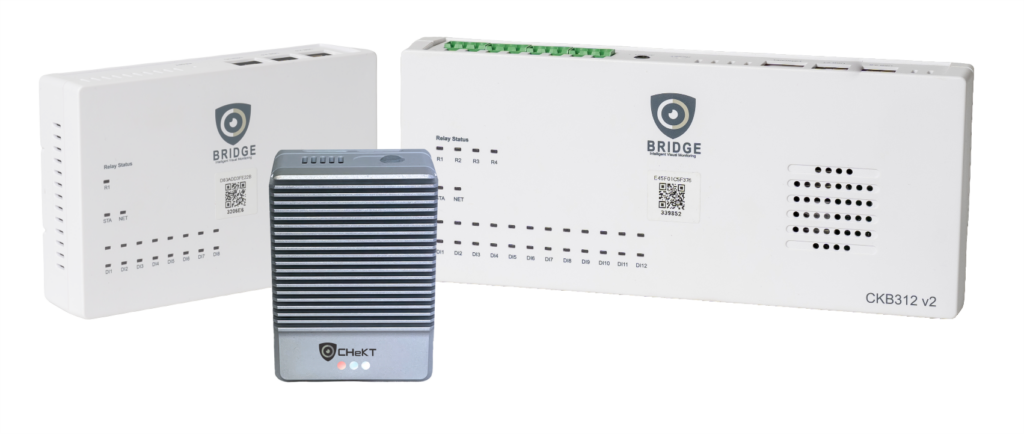
At the heart of the CHeKT ecosystem is the onsite CHeKT Video Control Panel (VCP). It unifies cameras, sensors, video analytics, IP speakers, analog audio, relays, wired inputs and outputs, and third-party API webhooks into a single cloud-managed platform.
In effect, the VCP acts as an operational shock absorber by absorbing the variability found across countless field deployments. Meanwhile, it delivers a predictable experience for installers, support teams, monitoring center operators, and end users alike.
Rather than relying solely on cloud processing, the VCP performs the heavy lifting onsite by buffering video streams, normalizing alarm sources, and maintaining supervision before sending a clean, standardized signal to the monitoring center.
Consequently, this architecture makes CHeKT one of the industry’s most reliable video alarm platforms for professional security deployments.
Video Stream Normalization Across Camera Brands
For integrated IP cameras, the CHeKT VCP uses an intelligent onboard video buffer to normalize video streams across supported camera brands. As a result, cameras from different manufacturers behave like cloud-enabled alarm cameras within the CHeKT ecosystem.
This normalization enables true remote video monitoring at scale. Security operators receive the same structured video alarm experience regardless of the camera brand, whether the deployment includes Hanwha, Axis, Uniview, or hundreds of other supported manufacturers.
When a video alarm occurs, the VCP creates standardized pre-alarm and post-alarm video evidence while simultaneously making live video available to monitoring center operators. This gives operators the visual context they need without requiring an onsite NVR, hard drive, camera port forwarding, or brand-specific workflows.
As a result, the complexity of mixed-brand deployments disappears at the VCP, allowing operators to focus on proactive monitoring instead of signal decoding.
Alarm Event Normalization
CHeKT also standardizes how alarm events are created.
A video alarm can originate from onboard camera analytics, a wired analog alarm input, a traditional sensor, an AI classification engine, or a third-party API integration. Regardless of the source, CHeKT converts every activation into a consistent video alarm event that includes evidence, live video, supervision, and the workflow expected by the monitoring center.
This alarm verification layer is critical for professional central station alarm monitoring operations. Operators no longer need to interpret raw sensor data or navigate brand-specific interfaces. Instead, every video-verified alarm arrives in a standardized format:
- A timestamped clip
- Live stream access
- Site context
- Clear action workflow
This way, reliable, high volume alarm verification becomes the standard.
Every Alarm, Standardized
| Alarm Source | Standardized by CHeKT |
| Camera Analytics | ✓ |
| Wired Inputs | ✓ |
| Analog Sensors | ✓ |
| Relay Outputs | ✓ |
| AI Object Classification | ✓ |
| Third Party APIs | ✓ |
CHeKT polling and supervision technology helps ensure the availability of the VCP, video streams, alarm sources, and the alarm transmission path to the monitoring center. For managed services, supervision is essential wherever reliable video alarm transmission and continuous system availability are required.
Polling, Supervision, and System Reliability
Furthermore, CHeKT’s built-in supervision capabilities provide operators and security companies with continuous visibility into system health while maintaining alarm transmission integrity across challenging network environments.
Instead of waiting for customers to discover failures, supervision identifies communication issues before they become customer complaints. Consequently, monitoring centers gain greater confidence that alarm events will arrive when they are needed.
AI Classification and False Alarm Reduction
Reducing Unnecessary Dispatches
CHeKT’s cloud-based AI object classification adds another layer of consistency by filtering events for people, vehicles, and other object types before they reach monitoring center agents.
False alarm reduction is more than an efficiency metric. Dispatching emergency responders based on unverified alerts creates unnecessary costs for monitoring centers, security companies, and end customers. By combining video-verified alarm delivery with AI pre-screening, CHeKT helps monitoring operations improve response confidence while reducing unnecessary dispatches.
Extending AI Beyond Camera Analytics
The same approach also strengthens traditional alarm systems. Wired sensors can be paired with CHeKT’s video object classification, allowing previously blind sensor activations to be verified as either genuine threats or non-threat conditions.
Benefits for Installers and Monitoring Centers
The greatest value for installers extends beyond the technology itself. CHeKT reduces the total cost of ownership while simplifying large-scale deployments. It enables faster installations, easier remote support, fewer site-specific variables, and a more repeatable deployment model across supported hardware.
Likewise, monitoring centers benefit from improved operator efficiency and higher response quality. Operators can respond through a consistent workflow that includes live video, alarm clips, site controls, and supervised system health across a wide range of deployments.
Ultimately, this operational foundation makes professional security camera monitoring truly scalable.