Proactive Retail Theft Prevention: Why CCTV Alone Isn’t Enough and What Modern Retail Security Requires
Retail theft is rarely one dramatic event. For most retailers, loss builds quietly through shoplifting, organized retail crime (ORC), and after‑hours incidents that repeat week after week. Together, these losses now exceed $100 billion annually in the US, turning retail security into a material business risk rather than a store‑level nuisance
Yet many retailers still rely on security systems designed primarily to record incidents, not prevent them. Cameras capture footage. Alarms trigger after breaches. Video is reviewed after the fact. The result is documentation but little deterrence.
This guide is for retail leaders actively evaluating retail security camera systems and proactive retail theft prevention strategies. It explains why traditional CCTV alone falls short, what a modern retail surveillance system must do differently, and how proactive visual security platforms like CHeKT change the equation by enabling real‑time detection, verification, and deterrence.
Retail Theft Is a Systems Problem, Not a Camera Problem
Retail theft today takes multiple forms:
- Shoplifting, both opportunistic and organized
- Organized retail crime, where coordinated groups target multiple locations
- Employee theft, often occurring in stockrooms or after hours
Each of these behaviors unfolds differently in time and space. A shoplifter may linger near high‑value items. ORC groups test entrances and coordinate distractions. Employee theft happens where cameras exist, but no one is watching in real time.
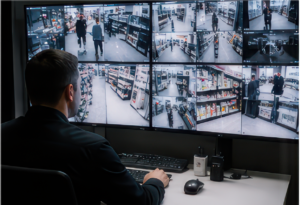
A retail CCTV system records all this activity. But recording is not the same as responding.
The core issue isn’t camera placement or resolution. It’s that traditional systems create a gap between when suspicious behavior begins and when anyone can act. That gap often measured in minutes or hours is where most retail loss occurs.
What Traditional Retail CCTV Actually Does (and Doesn’t Do)
Standard retail video surveillance still provides real value:
- Acts as a visual deterrent for opportunistic theft
- Supplies evidence for insurance claims and police investigations
- Integrates with POS systems to flag transaction anomalies
- Offers a relatively low cost of entry
But its limitations are structural:
- Footage is reviewed after incidents occur
- Motion‑based alerts generate high false‑alarm rates
- DVRs can be unplugged, damaged, or stolen
- Cameras can’t interpret behavior, only movement
- Monitoring centers receive alarms without context
A CCTV camera for a retail shop that only records is a documentation tool. It cannot distinguish browsing from concealment, staging from coincidence, or risk from routine activity.
Retail security has evolved beyond recording. Prevention requires intelligence, context, and the ability to intervene while a situation is still unfolding.
What a Modern Retail Surveillance System Should Actually Do
A modern video surveillance system for retail must support proactive loss prevention not just passive monitoring. At a minimum, it should deliver six capabilities.
- AI Behavioral Detection
Modern systems analyze behavior, not just motion. AI can detect loitering near high‑value merchandise, perimeter breaches after hours, or unusual movement patterns filtering out routine activity and focusing attention on real threats.
- Real‑Time Alert Routing
Detection events must route instantly to a live operator with full visual context. Alerts without live video force guesswork and delay response.
- Two‑Way Audio
Two‑way audio is the inflection point between detection and prevention. A live operator issuing a real‑time voice warning rather than a recorded message creates immediate deterrence that passive cameras cannot.
- Verified Alarm Dispatch
Law enforcement deprioritizes unverified alarms. Systems that provide live video verification enable faster, higher‑confidence dispatch.
- Cloud‑Based Video Surveillance
Local DVR storage alone is a vulnerability. Cloud-recorded verified event footage ensures evidence survives hardware damage and is accessible remotely.
- Scalability for Multi‑Location Retail
Security systems for chains and franchises must have centralized configuration, consistent response protocols, and portfolio‑level visibility. A system that can’t scale creates operational friction instead of reducing it.
Choosing the Best Retail Security Camera System: What to Evaluate
When evaluating the retail store camera systems, retail leaders should look beyond resolution specs and focus on how well the system supports real‑time prevention and response.
Resolution and Coverage — High‑resolution cameras with the right field of view are essential, particularly at checkout areas, entrances, and high‑value merchandise zones. Image clarity matters most when footage must support live decision‑making, not just post‑incident review.
Indoor vs. Outdoor Capability — Effective retail theft prevention requires both interior and exterior coverage. Exterior cameras should support low‑light performance and weather resistance for parking lots, loading docks, and side entrances, while interior cameras should provide discreet, customer‑friendly coverage.
AI Analytics: Edge vs. Cloud — Some systems process analytics on the camera itself, while others rely on cloud‑based analysis. Cloud‑based AI models are often easier to update and scale over time, allowing detection capabilities to evolve without replacing hardware.
Alarm Panel Integration — Camera systems that operate separately from alarm panels create fragmented workflows. Integration enables video‑verified alarms, unified monitoring, and faster, more confident response.
Monitoring Model: Self‑Monitored vs. Professionally Monitored — Self‑monitored systems send alerts to a mobile app, leaving response to store staff. Professionally monitored systems connect cameras to trained operators who can verify threats in real time, activate deterrents, and coordinate law enforcement response. For after‑hours risk and multi‑site retail security, professional monitoring is typically essential.
How CHeKT Makes Retail Video Surveillance Proactive
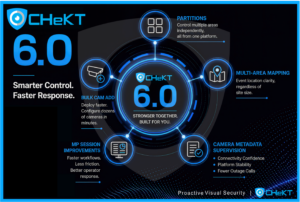
CHeKT was built to close the gap between detection and action by transforming traditional cameras into real‑time security tools.
AI‑Powered Detection
CHeKT continuously analyzes live video feeds using AI to identify behaviors such as loitering, unauthorized access, and suspicious movement rather than triggering on every motion event. This reduces false alarms and surfaces real risk earlier.
Live Video Verification
When a detection event occurs, operators see live video immediately, not a single clip after the fact. This context enables faster, more confident decisions and eliminates the uncertainty that slows response.
Two‑Way Audio and Visual Deterrence
Through integrated IP speakers and deterrent devices, operators can issue live voice warnings, activate lights, or trigger sirens in real time. This intervention layer is often enough to stop theft before it escalates.
Video Control Panel: The Intelligence Layer
CHeKT’s Video Control Panel acts as the bridge between cameras, AI analytics, and alarm systems routing verified video events to monitoring centers and users in seconds. Operators don’t react blindly; they act with visual proof.
Video Vault: Cloud‑Stored Evidence
Verified event footage is stored securely in the cloud, not on vulnerable local hardware. Retailers gain clean, timestamped evidence for investigations, insurance, and prosecution.
Built for Multi‑Site Retail
CHeKT is designed for consistent deployment across multiple locations with one platform, one monitoring workflow, and centralized oversight across an entire retail footprint.
Real‑World Applications in Retail
Retailers are already using proactive visual security to change outcomes:
- Multi‑site retailers detect suspicious behavior before theft occurs, enabling intervention without relying on store staff
- After‑hours live monitoring and deterrence benefits environments where employees aren’t present
- High‑value merchandise areas gain protection through behavioral detection rather than constant manual review
In warehouse and distribution environments, similar proactive monitoring has helped eliminate repeated theft by detectingperimeter breaches and enabling real‑time response across multiple sites.
Building a Complete Proactive Retail Theft Prevention Program
Technology alone doesn’t stop retail theft. The strongest programs align three layers:
- Technology — AI cameras, live monitoring, alarm integration (CHeKT)
- Process — clear response protocols, escalation paths, documentation
- People — trained staff, loss‑prevention teams, law‑enforcement coordination
CHeKT strengthens the technology layer that makes the other two effective. When staff know cameras are actively monitored and operators can intervene in real time, deterrence becomes shared, not theoretical.