How to Prevent Retail Smash‑and‑Grab Theft: A Complete Guide
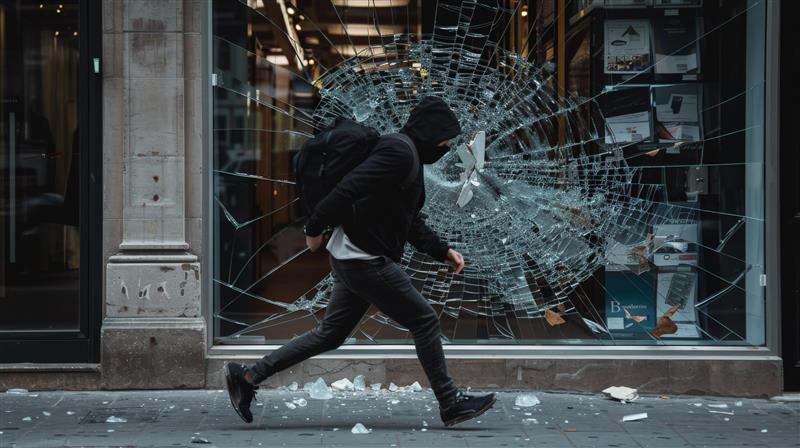
Smash‑and‑grab theft has surged nationwide, contributing to more than $112 billion in annual retail shrink. These incidents aren’t limited to big‑city luxury stores — retailers of all sizes, from jewelry stores and electronics shops to auto dealerships and specialty retail, are seeing fast, coordinated attacks that cause major financial loss in seconds. Traditional retail smash-and-grab prevention measures like CCTV, alarms, or reinforced glass help, but they’re no longer enough on their own.
This guide breaks down where standard advice falls short—and how a modern, proactive security framework, including AI-powered detection and real-time intervention, can help protect your business before damage occurs.
Why Smash‑and‑Grab Theft in Retail is Rising — And Harder to Stop
Retail smash‑and‑grabs are increasing for reasons that often have nothing to do with your store. Today’s attacks are faster, more coordinated, and often involve organized retail crime groups. These crews know how to strike and disappear before anyone can respond.
Proactive strategies for smash‑and‑grab prevention in retail should include AI-powered detection, real‑time video verification, and layered security.
Modern smash‑and‑grab attacks typically share these traits:
- They’re over in under ninety seconds. By the time an alarm sounds, a thief has already broken glass, grabbed merchandise, and fled.
- They’re highly coordinated. Getaway drivers, lookouts, multiple entry points — these groups often operate with a level of planning that overwhelms traditional defenses.
- They target more than luxury boutiques. Electronics retailers, jewelry shops, pharmacies, and even liquor stores are increasingly hit due to high‑value, easily resold items.
- Law enforcement response times don’t match the speed of the crime. Even in major cities, police response time averages several minutes. Many smash‑and‑grabs take 60–120 seconds.
Traditional CCTV and intrusion alarms are not built to respond at this pace. They record what happened—but only after the damage is done.
Smash‑and‑grabs exploit the critical gap between the start of suspicious activity and the moment anyone becomes aware of it. Closing that gap is the key to prevention.
The Standard Advice — And Where It Falls Short
If you’ve researched “how to prevent retail theft,” you’ve probably seen the same checklist. These measures still matter, but they’re not enough to stop determined or organized groups:
- Window film and reinforced glass slow entry by a few seconds—but not enough to stop multiple attackers with tools.
- Better lighting and visibility deter opportunistic theft, but organized crews operate regardless of lighting.
- Traditional CCTV installations document incidents after the fact—they don’t alert you in time to intervene.
- Conventional alarms follow a slow chain: Alarm → monitoring → dispatch → response. By the time help arrives, the crime is over.
- Employee training helps during the day but is irrelevant after hours (when most smash-and-grabs occur).
These are important foundational layers—but today’s threat environment requires an active layer that detects suspicious behavior, verifies it instantly, and initiates real-time deterrence.
What “Proactive” Security Actually Means
Proactive security means your system helps you act before or during an incident — not after it.
Here’s the difference:
Reactive security (traditional)
- Camera records
- Alarm triggers after break‑in
- Monitoring center notified
- Police dispatched
- Crime is already completed
Proactive security (modern)
- AI detects suspicious activity (loitering, casing, perimeter breach)
- Operators see live video instantly
- Audio/visual deterrents activate immediately
- Police receive real‑time visual intelligence
- Offenders are deterred, or caught, before significant loss occurs
This proactive video monitoring approach is especially relevant for smash-and-grab prevention in retail, because these crimes begin before the glass breaks.
Proactive video monitoring for retail captures that early window where action can still change the outcome.
How CHeKT Helps Prevent Smash‑and‑Grab Theft (Using Your Existing System)
This section breaks down how to prevent retail theft with proactive visual security using capabilities directly reflected in the CHeKT platform.
AI‑Powered Detection — Spot Suspicious Behavior Early
CHeKT cameras, connected through the CHeKT Video Control Panel, use AI analytics to detect:
- Loitering
- Perimeter breaches
- Unusual movement patterns
- Groups gathering after hours
Instead of triggering on every passing car or shadow, AI filtering reduces false alarms and focuses attention only on real threats.
For retail businesses, this means:
- Exterior cameras can detect groups casing the storefront
- Cameras near display windows can identify lingering near high‑value merchandise
- Parking lot surveillance can catch staging behavior before a break‑in
This early warning creates a chance to intervene before an attack begins.
Real‑Time Alarm Verification — No More Guessing
When a suspicious event is detected, CHeKT doesn’t just send a vague alert. It delivers immediate live video of what’s happening.
This bridges the gap between:
- “Motion detected”
and - “Three masked individuals are approaching the side entrance with tools.”
Real-time verification allows retailers to:
- Reduce false alarms
- Prioritize response with high confidence
- Deliver credible, verified intelligence to police
- Act fast enough to prevent loss, not just report it
Live verification of video from retail security cameras also builds trust with law enforcement, who often deprioritize unverified alarms.
CHeKT integrates with IP speakers, strobe, and lighting to enable live, real-time deterrence.
Audible and Visual Deterrents — Stopping Crime as It’s happening
Operators can communicate instantly with a voice warning such as:
“Security is monitoring this property. Law enforcement has been notified.”
This unexpected direct confrontation often stops an attack on the spot. Proactive deterrence:
- Interrupt the crime
- Disrupts coordination among offenders
- Forces offenders to flee
- Protects stores from damage
This is where proactive systems outperform passive CCTV installations because they interact with the crime.
Parking Lot Surveillance and Perimeter Coverage
Most smash‑and‑grabs begin in the parking lot:
- Staging vehicles
- Tools being readied
- Blocking exits
- Assigning lookout roles
- Testing lighting or alarms
- Escape routes being set
With proactive monitoring:
- AI security cameras for retail stores detect these behaviors early
- Operators can verify intent in real time
- Deterrence can begin before anyone approaches the building
This matters most for retail categories heavily targeted in smash-and-grab theft:
- Electronics
- Jewelry
- Liquor
- Pharmacies
These businesses often have large storefront windows facing open parking lots that criminals exploit.
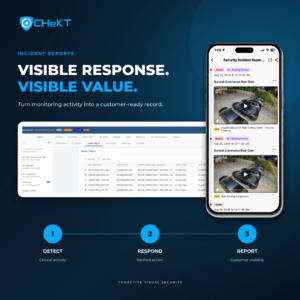
Cloud Video Vault — Evidence That Works
Verified video events stored in the cloud ensure you always have:
- Clean, timestamped evidence
- Accessible footage for police and insurance
- Shareable links for investigators
- Reliable records that don’t get overwritten
For retailers experiencing repeated smash‑and‑grabs, this is critical for outcomes and recovery.
Real‑World Proof: How Retailers Use CHeKT
According to RILA, organized retail crime now carries a $125 billion economic impact when factoring in lost sales, safety risks, and community effects — meaning each incident contributes to a much larger industry problem.
Here are two real examples drawn from CHeKT case studies:
1. Retail: Real‑Time Video Prevented Loss
A retail business facing repeated after-hours theft used CHeKT live video, AI detection, and visual deterrents to stop incidents before they escalated. Operators intervened the moment suspicious activity was detected, resulting in reduced loss and improved safety for staff.
2. Wine Distributor: Eliminating Theft in Remote Areas
A wine distribution center targeted due to its remote location deployed CHeKT for perimeter breaches and guide real-time operator response. The result: theft attempts dropped dramatically across multiple sites.
These examples show how proactive visual security leads to real outcomes, not hypothetical ones.
A Layered Security Plan for Retailers
No single tool prevents all smash-and-grabs. The strongest approach is a layered defense model:
Layer 1 — Physical Deterrents
- Reinforced glass
- Window film
- Secure display cages
- Bollards or planters
These slow attackers but don’t stop organized retail crime groups.
Layer 2 — Passive Monitoring
- Interior cameras
- Exterior cameras
- Traditional alarms
Valuable for evidence — limited for prevention.
Layer 3 — Active Intelligence (Where CHeKT Fits)
- AI-powered detection
- Live video verification
- Real-time operator intervention
- Audio and visual deterrence
- Verified dispatch
This is the missing layer in most retail environments—and the key to smash-and-grab prevention.
Layer 4 — Response Protocols
- Staff safety procedures
- Coordination with law enforcement
- Consistent incident reporting
- Shared evidence
When all four layers work together, retailers gain the ability to detect early, intervene fast, and meaningfully reduce loss.
As smash‑and‑grab incidents continue to escalate, retailers need security that can keep pace with modern threats. While traditional cameras and alarms still play an important role, true protection comes from bridging the critical gap between the moment suspicious activity begins and the moment someone can respond. By adding real‑time detection, live video verification, and immediate deterrence, CHeKT helps retailers shift from documenting losses to actively preventing them. With a proactive visual security approach that works with your existing systems and scales as your business grows, you gain the awareness and control needed to protect your storefront, your inventory, and your peace of mind.