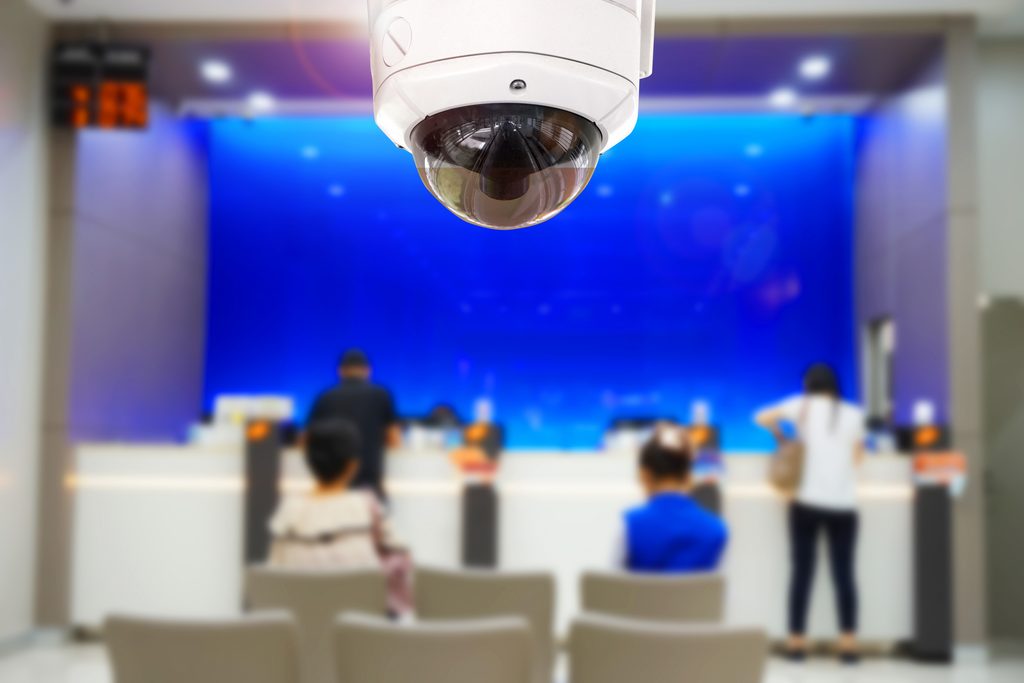
Walk into almost any branch and you’ll pass a dozen bank security cameras before you reach the teller line — entrance, lobby, counter, vault corridor, ATM, drive-thru — and yet incidents still run start to finish with nobody intervening, and the footage that surfaces afterward is often too soft to identify anyone.
That isn’t a camera problem. It’s a monitoring problem. This article covers what actually stops an incident while it’s happening, rather than what records one for the claim file.
Why Bank Security Cameras Still Fail Banks and Credit Unions
Search “bank security cameras” and you’ll find people openly joking about how bad the footage is. It’s a fair joke, and the reasons behind it are specific.
Search “bank security cameras” and you’ll find people openly joking about how bad the footage is. It’s a fair joke, and the reasons behind it are specific.
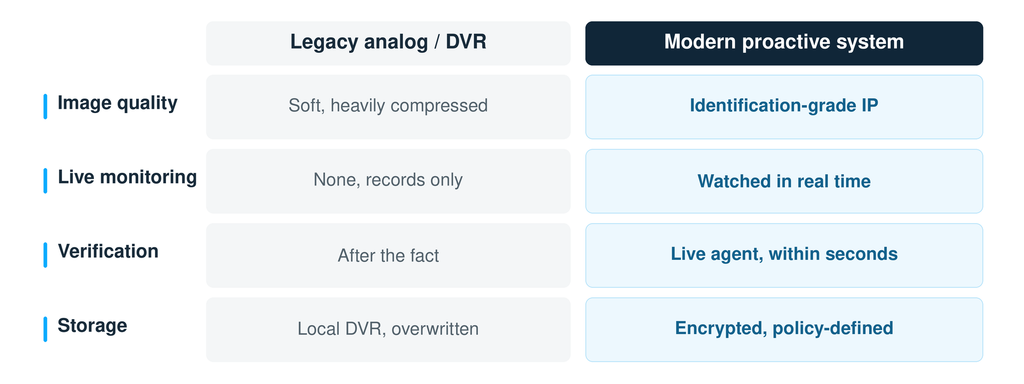
Many branch systems are still analog composite video recorded to a DVR, often sixteen channels squeezed onto one recorder. To fit that many streams on the available storage, the recorder compresses hard and drops frame rate, so a person crossing the lobby becomes a handful of smeared frames. Cameras were positioned for broad coverage rather than identification-grade framing, which means a wide shot of the teller line but no view tight enough to resolve a face. Systems were specified to satisfy an insurer’s minimum, then left in place for a decade while IP camera technology moved on without them.
Branch networks compound it. A multi-camera site running on a connection sized for core banking traffic has little headroom for video, so retention windows shorten and streams get throttled further.
The deeper issue is architectural: these systems record, but nobody is actually watching. Footage is reviewed after the fact, when the only remaining question is who did it, not whether it can be stopped. Remote video monitoring changes that premise: the feed is being watched while the event is still in progress, which is the only point at which the outcome is still open.
Where Banks and Credit Unions Actually Need Video Surveillance Coverage
Not every zone needs the same thing. Coverage planning for security cameras for banks should follow what each area is actually for.
Entrances and exits. Identification-grade framing at head height, positioned so faces aren’t backlit by glass doors. This is the footage that ends up in an investigation.
Teller line. Clear view of the transaction counter and the customer side, with enough resolution to distinguish individuals rather than just confirm that someone was present.
Vault and restricted areas. Access-controlled spaces where the question is who entered, when, and whether they were authorized.
ATM and drive-thru lanes. Both the machine face and the approach, so a device attached to the card reader is visible before a customer uses it.
Night drop. After-hours activity here is rarely legitimate and is one of the clearest candidates for live monitoring rather than recording alone.
Parking and perimeter. Where loitering starts, and where remote video monitoring for banks can intervene before anyone reaches the building.
ATM-Specific Threats: Jackpotting and Skimming
ATMs sit outside the branch’s staffed envelope, which is exactly why ATM security cameras need to do more than record.
Jackpotting is a logical attack on the machine itself. The U.S. Secret Service has warned financial institutions that attackers gain physical access to an ATM and install malware, specialized electronics, or both, forcing it to dispense large volumes of cash on demand. Standalone and drive-thru machines are the common targets. The tell is physical and visible: someone at the machine for an unusual length of time, working at the housing rather than the keypad.
Skimming is a data attack. A reader overlay or internal tap captures card data, usually paired with a pinhole camera or overlay keypad to capture the PIN. Devices are designed to look factory-standard and are often placed and retrieved within a single quiet window.
Both are detectable while they’re happening, but not by a camera that only writes to disk. An after-hours alert on ATM approach, verified by a person within seconds, is the difference between an intervention and a report.
What Modern Bank Security Camera Systems Add: Detect, Verify, Deter, Respond
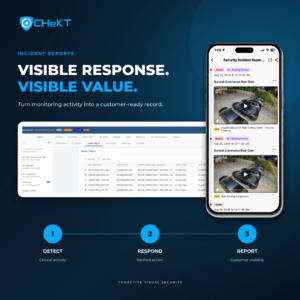
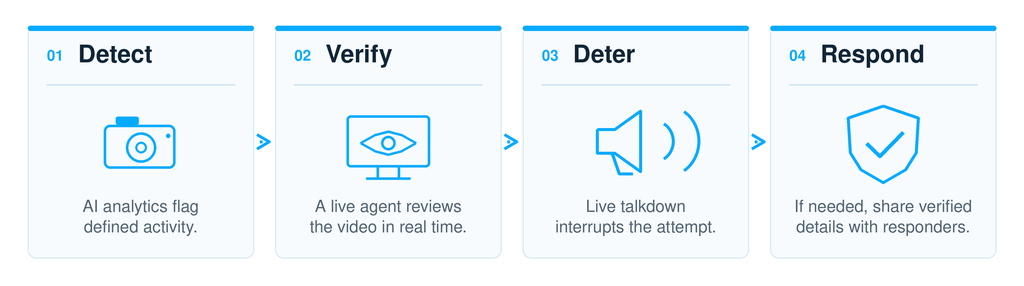
Every vendor in this space sells better cameras and smarter analytics. Almost none explain what happens in the seconds between an alert firing and a human doing something about it. That sequence is the product. CHeKT runs it as four distinct steps.
1. Detect
AI analytics flag a defined event: a person at the ATM after closing, movement at the night drop, someone lingering at the perimeter. It’s a trigger, not a verdict. Analytics are good at noticing that something happened and unreliable at judging what happened — a delivery driver, a maintenance tech, and a break-in attempt can all produce the same motion event.
2. Verify
A live agent opens the real-time feed and looks. Within seconds, a person — not a model — determines whether this is an actual threat or a false alarm. That’s what separates a monitored system from one that simply fires alerts. AI-only systems push the judgment call onto branch staff or a dispatcher who can’t see the scene. Live video verification means that decision is made by someone already looking at the footage.
3. Deter
If the event is real, the agent speaks directly to the person on site through the camera’s speaker. Live audio deterrence, or talkdown, interrupts the attempt while it’s still an attempt — at the perimeter, at the night drop, at the ATM — rather than after a vault or teller line has been reached. Being addressed by name and description by someone clearly watching in real time ends a surprising number of incidents on its own.
4. Respond
When intervention doesn’t resolve it, what reaches police, a guard service, or your own security team is a verified event with confirmed context: what’s happening, where, how many people, and what they’re doing — not an unattributed alarm signal that leaves responders guessing. CHeKT has documented verified response leading to apprehension on exactly this sequence.
This is the shift from reactive to proactive video monitoring — what CHeKT calls Proactive Visual Security.
Compliance and Data Security for Bank Video Systems
This section is provided for general informational purposes and is not legal or compliance advice. Confirm current requirements with your compliance officer or counsel.
Four frameworks shape how a bank surveillance system handles, stores, and protects video. The Gramm-Leach-Bliley Act (GLBA) governs safeguarding customer information, which extends to any system capturing and storing customer images and data. The Bank Secrecy Act (BSA) drives recordkeeping obligations that video often supports. The Federal Financial Institutions Examination Council (FFIEC) issues the examination guidance your regulators work from. And the Payment Card Industry Data Security Standard (PCI DSS) applies wherever cardholder data lives.
Retention is where the guidance gets less straightforward than it sounds. Federal bank security regulations issued under the Bank Protection Act of 1968 — 12 CFR 21.54 for national banks, 12 CFR 326 for FDIC-supervised institutions, 12 CFR 208.61 for state member banks — list maintaining a camera that records activity in the banking office as a procedure a security program may include, and set no retention period at all. Your board-designated security officer’s written security program defines it. PCI DSS v4.0 Requirement 9.2.1.1 does set a floor of three months, but only for sensitive areas within the cardholder data environment — not the public lobby. State law may add more.
That makes storage a design decision rather than a checkbox: encrypted, tamper-resistant, and retained on a policy you can defend to an examiner. CHeKT Video Vault handles that side. The system’s own attack surface matters equally — a camera network reachable from the internet is a liability, which is why securing remote access to the camera system belongs in the same conversation.
Where This Applies: Branches, Credit Unions, and Multi-Location Networks
The threat categories are consistent across the vertical: robbery, ATM jackpotting, skimming, insider threats, and after-hours night-drop break-ins. What changes is scale. A single branch can be managed with local relationships and a local installer. A twenty-branch network managed that way becomes twenty different systems, twenty vendors, twenty retention policies, and no consistent answer when a regional security manager asks what happened at a specific site last Tuesday.
Standardizing on one monitored platform means the same detection rules, the same verification standard, and the same response path at every location, visible from one dashboard. That’s the model behind CHeKT’s proactive visual security for banks and credit unions — built for institutions evaluating protection across a network, not site by site.

What to Look for in a Modern Bank Security Camera System
- Live human verification, not AI-only alerts — confirm a person reviews the feed before escalation
- Two-way audio at the camera for real-time talkdown, not just recorded announcements
- Encrypted storage with configurable retention that maps to your written security program
- Integration with your existing alarm panel, so video verification attaches to signals you already generate
- Hardened remote access — no port forwarding, no default credentials, no directly exposed recorders
- One dashboard across all branches, with role-based access for regional and corporate security
- Identification-grade camera placement at entrances and ATMs, specified deliberately rather than inherited
- A local installer network for service and response, not a national ticket queue
- Ready to see what this looks like at your branches? Find a CHeKT provider near you.