Industrial Perimeter Security Systems: How to Detect, Verify, and Deter Threats in Real Time
The outer boundary of your site is your first zone of protection, but what happens when a trespasser breaches that line at 2:00 AM?
If your industrial perimeter security relies solely on passive cameras, you might not find out until the next morning, long after the damage is done. The statistics are sobering: joint historical reports by the National Equipment Register (NER) and the National Insurance Crime Bureau (NICB), estimated approximately 70% of heavy equipment theft takes place over the weekend or at night when sites are unattended, costing the industry up to $1 billion annually with recovery rates below 25%.
Perimeter security systems are only as effective as the response they trigger.
While many sites can detect movement or record an event, recording an intrusion does not stop it. To truly protect your assets, you must close the gap between detection and response by verifying threats in real time, intervening while they unfold, and preserving audit-ready evidence afterward. This guide explores how to make that transition from passive observation to proactive protection.
What are the core layers of industrial perimeter security?
Before you can fix the response gap, it helps to understand how a typical boundary is built.
An effective perimeter strategy combines physical, electronic, and operational layers. Each layer has a specific job, but each also has a critical limitation if it operates alone.
| Layer | What it does | Where it falls short alone |
| Fencing, gates, and anti-ram barriers | Defines the boundary, controls entry points, and helps deter or delay intrusion | Does not confirm whether a breach attempt is real, accidental, or active |
| Lighting | Improves visibility and industrial perimeter security camera performance | Better visibility does not equal an active response |
| Intrusion sensors | Detects motion, vibration, gate activity, or perimeter breaches | Can generate nuisance alerts without visual context |
| Cameras and analytics | Captures video and can identify activity patterns or trigger alerts | Detection and recording do not stop an intrusion by themselves |
| Access control | Restricts who can enter gates, doors, and controlled areas | Credential events without video context may leave unanswered questions |
| Monitoring and response | Determines whether an event is real and what action should follow | If response is slow, inconsistent, or disconnected from video, the system remains reactive |
The operational takeaway is simple: perimeter protection works best when these layers are connected to a verified-response model, not treated as isolated components.
How to design an industrial perimeter monitoring strategy
Even the best physical barriers fail if they aren’t deployed with purpose. Before selecting cameras, analytics, or perimeter security monitoring workflows, start with a comprehensive risk assessment.
The goal is to define where risk concentrates, what must be verified, and who owns the response.
Perimeter monitoring risk-assessment checklist
- Where are the primary entry and egress points, including fences, gates, and bollards?
- Which areas have blind spots, long sight lines, or limited nighttime visibility?
- Which exterior assets would create the highest operational or financial impact if stolen or damaged?
- What incidents are most likely after hours: trespass, theft, tailgating, gate misuse, or vandalism?
- Who owns the response when an alert occurs: internal guards, a remote monitoring team, or local law enforcement?
- Does each perimeter monitoring zone have reliable power, network connectivity, and camera coverage?
- How long does footage need to be retained for investigations, compliance, or liability questions?
- Should perimeter events be reviewed alongside gate or access activity for added operational context?
- If you operate multiple sites, can you standardize the same monitoring model across all of them?
The right design helps your team move from simply knowing “something triggered” to knowing exactly “what happened and what to do next.”
Why passive perimeter surveillance leaves a response gap
Many perimeter surveillance programs are built to detect and record, but the biggest failure point is often the gap between that detection and a meaningful response.
Detection means a sensor or rule identifies activity. Verification means a person uses remote video monitoring to determine whether the alert reflects a real threat. Deterrence means acting during the event, such as delivering a live warning through an IP speaker.
Without video verification, teams are forced to treat every alert the same. This creates immense friction in environments with weather movement, low-light scenes, wildlife, or broad industrial footprints.
In fact, law enforcement data reveals that up to 98% of all security alarm activations in the U.S. are false alarms, consuming an estimated $1.8 billion in emergency response resources annually.
Passive perimeter surveillance vs. proactive visual security
| Passive perimeter surveillance | Proactive visual security with CHeKT |
| Detects or records activity | Detects activity and supports live video verification |
| Often relies on post-event review | Helps teams assess events while they are unfolding |
| May overwhelm teams with nuisance alerts | Adds live context so alerts can be prioritized |
| Usually documents what happened | Supports intervention, escalation, and audit-ready evidence |
| Varies by site and operator | Can be standardized across distributed locations |
For operations leaders, a passive system is an uptime and liability issue. A 40-year systematic review by the Campbell Collaboration emphasizes this limitation, finding that while traditional CCTV reduces crime by about 13%, systems incorporating active monitoring generate significantly larger crime reductions—up to nearly 50% in managed exterior areas.
How proactive visual security works at the perimeter
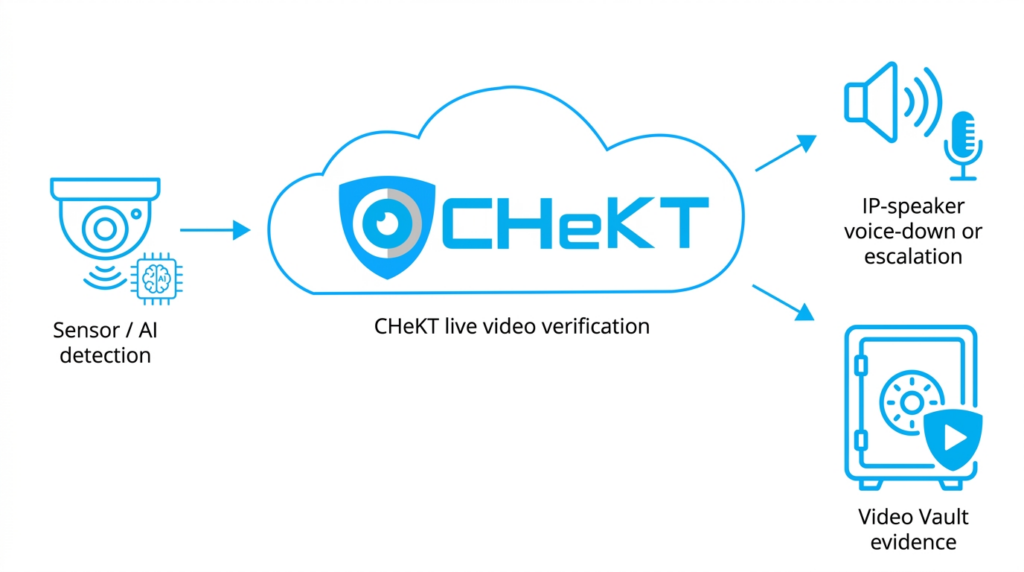
So, what does an active response actually look like? A proactive model connects detection, verification, deterrence, escalation, and evidence retention into one continuous operating sequence.
Detection-to-response workflow
- Analytic or sensor alert – Activity at the fence line, gate, or remote boundary triggers a real-time security alert.
- Live video review – An operator uses live video monitoring to review the associated feed and determine what is happening in real time.
- Threat verification – The event is classified as nuisance activity, routine site behavior, or a real security concern using video verification.
- IP-speaker deterrence – If appropriate, a live voice warning is delivered through networked speakers to address the individual at the perimeter.
- Notify or escalate – The event is escalated to site personnel, a response partner, or law enforcement based on the verified situation.
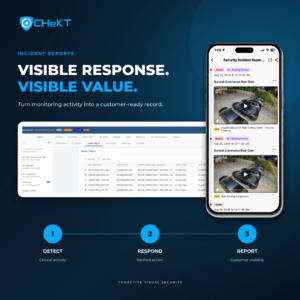
- Preserve event footage – Verified event footage is retained for later review, training, or internal reporting.
Crucially, this model supports modernization without a full rip-and-replace approach. CHeKT adds the response layer on top of existing perimeter investments, connecting directly to your current cameras.
CHeKT capabilities for industrial perimeter security
Executing this workflow requires the right technology stack. The perimeter use case becomes highly practical when backed by five core proof pillars:
Live video verification
Video verification helps teams distinguish between activity that needs action and activity that does not. The Partnership for Priority Verified Alarm Response (PPVAR) notes that traditional, unverified alarms have an arrest rate of just 0.02%.In contrast, a video-verified alarm acts as a virtual eyewitness, upgrading the event to a “crime in progress” and guaranteeing a prioritized police response.
IP-speaker deterrence
Instead of only documenting a trespass, an operator can issue a live, targeted warning while the event is in progress. CHeKT Speakers support location-specific voice-down intervention, proving that perimeter security can include an active response step.
CHeKT Video Vault and audit-ready footage
A perimeter event often creates downstream work: insurance support, liability investigation, or law-enforcement follow-up. Retaining audit-ready footage is critical. Video Vault supports cloud retention and easy retrieval, ensuring operations leaders are not left searching through fragmented 24/7 video surveillance recordings.
Access-control context
When a credential event or gate action can be reviewed alongside visual context, teams get a complete operational picture.CHeKT correlates video with access activity, providing deep context for perimeter review.
Multi-site standardization
For operators managing multiple locations, the goal is to create a repeatable operating model. CHeKT standardizes consistent awareness and verified response across distributed portfolios.
Perimeter-security use cases for national and multi-site operators
These capabilities translate directly to real-world environments where exterior assets and after-hours exposure create operational risk.
Equipment yards and exterior assets
Heavy-equipment environments combine open lots and high-value mobile assets, making them ideal candidates for perimeter detection paired with remote video surveillance.
Automative dealerships & rental sites
Unguarded vehicle lots are increasingly targeted for high-value inventory and lucrative parts making a clear protection plan a must.
Hazardous materials and critical infrastructure
Facilities handling regulated materials face elevated liability exposure. In these high-risk environments, verified awareness and industrial perimeter security ensure a boundary event doesn’t escalate into a massive compliance issue.
Manufacturing, logistics, and warehouse sites
Loading areas, trailer yards, and wide site footprints benefit from standardized escalation and evidence handling across multiple distributed locations.
Employee and contractor safety at isolated areas
Perimeter security is also a vital life-safety tool. The National Safety Council estimates that 15% of employees work in isolated environments, and nearly 70% of organizations report safety incidents involving lone workers. Monitoring remote gates ensures immediate visual context if a worker is threatened.
Questions to ask when evaluating perimeter security cameras and monitoring
Ready to upgrade your approach? Use the checklist below when comparing vendors or integrators for an industrial perimeter project.
Buyer checklist
- Can the system verify a perimeter event live, or does it only detect and record it?
- How are nuisance alerts reduced before they become an operational burden?
- Can the monitoring workflow support real-time voice warnings through IP speakers?
- How is event footage retained, retrieved, and prepared for audit-ready review?
- Can perimeter security cameras be reviewed alongside gate or access activity for added context?
- Does the solution work with existing cameras, or does it require a full rip-and-replace?
- How well does the perimeter security camera system perform across wide footprints, dark areas, and remote zones?
- What happens after a threat is verified, and who owns the escalation path?
- Can the same monitoring and response model be standardized across multiple sites?
- What connectivity and power constraints exist for remote perimeter locations?